My earlier posts on a-priori low frequency models (LFMs) generated several great discussions – too many to consider here.
But I’d like to comment on one in particular: using seismic velocities to complement (or even replace) well-log interpolated models. This is a great example of integrating all available data to improve your inversion results – but there are key things to consider before doing so (starting in this post and concluded in the first reply).
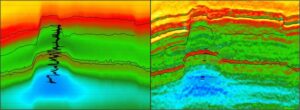
The image below is a great comparison of p-impedance inversion using a standard well-based low frequency model (upper panel) vs. the same model but supplemented with seismic velocities (lower). The lower panel has added detail. (Kumar and Singh, SPG India 2012)
Here are my five key considerations:
- What type of inversion will be used – “trace-based” or “model-based”?
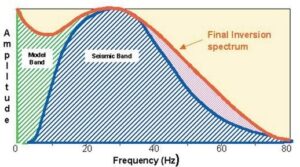
With trace-based inversions, the final output is driven by seismic alone (as much as possible). The a-priori model is used only to stabilize the low frequency gap below seismic bandwidth, generally ~0-6 Hz (depending on the seismic). These are “low frequency models”.
With model-based inversions, the final output is derived via a combination of both the seismic and a-priori model – they both contribute (to varying degrees) throughout the seismic bandwidth. This means the a-priori model is used throughout, not only for low frequencies. These are “starting models.”
Why is this distinction important? It determines how the a-priori models will be used, which in turn dictates different approaches and requirements for building them.
- What type of seismic velocities are available? Stacking/NMO, FWI, imaging (PSTM or PSDM), RMS, Average, Instantaneous…oh so many varieties.
Why is this important? To include seismic velocities in an a-priori model, they must be interval velocities (a vertical p-velocity, and ideally anisotropic). This best captures the true p-vels of the subsurface. FWI velocities are ideal, and they’re becoming more common – but they’re still quite expensive.
Most modern processing deliverables include interval velocities. But if not, one of the other formats must be converted.
- What type of seismic volumes will be inverted – a single post-stack, or multiple partial-stacks?
Post-stack is simplest, because only compressional p-impedance is derived, so only a p-impedance model is required. Pre-stack inversions derive both p-impedance and s-impedance, so the algorithm requires models for each.
Why is this important? Partial-stack inversions are elastic, and require both p- and s-impedance models. So when supplementing with seismic velocities, this requires both p- and s-velocities. Shear information from seismic is generally not determined (unless multi-component data, which is comparatively rare and expensive), so shear velocities must be estimated and calibrated from the seismic p-velocities.
Conclusion. We can only touch on these inversion model issues at a very high-level! Each of these factors opens its own advanced discussion. But that’s the nature of geophysics: scratch a simple topic and complexities are uncovered ✓