Reading about DHI’s in this month’s AAPG Explorer (July 2025) got me to thinking about flat spots.
There are many reasons why a flat spot – the seismic signature of a subsurface fluid contact – might not be flat.
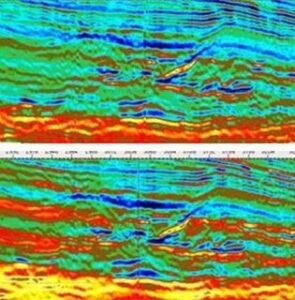
See this image of a flat spot that’s not very flat (“Detection of hydrocarbons using non-bright-spot seismic techniques,” Brown and Abriel, Interpretation 2014).
Flat spots are associated with changes in impedance for bodies of different fluids within a reservoir. The fluids – typically gas, oil, and/or water – separate into different bodies due to differences in density, and at the layer interfaces, seismic reflections are generated.
As you can imagine, in a glass jar with oil and water, the contact will be perfectly flat. And in subsurface reservoirs, many (perhaps most?) hydrocarbon flat spots are nearly flat – but not all of them. What could explain the exceptions? Some are real and some are artifacts.
— Seismic imaging issues. An inaccurate velocity model used either for migration or depth conversion can lead to flat spot signatures projected with a slope or curve. This is an artifact of incorrect subsurface imaging. (And let’s face it – all velocity models are inaccurate!)
— Fine internal differences in reservoir properties like porosity or permeability, and fluid factors like pressure gradients or capillary forces, may lead to a fluid contact following stratigraphy to some degree, leading to local deviations from a flat surface.
— Remnant or paleo flat spots – preserved “flat” reflections from an ancient flat spot, long after the hydrocarbons are gone. These may be due to preserved cementation differences that occurred from the different fluids. These “flat events” could be subsequently folded or uplifted to various degrees.
Given these uncertainties in the “flatness” of flat spots, the best way to recognize them is a seismic reflection that tends to cut across visibly existing stratigraphic events, regardless of how flat it is. And before announcing a new prospect, be sure to validate your seismic interpretations with a sound understanding of the geologic and depositional environment!
And I also haven’t even mentioned that all flat spots might not be fluid contacts – maybe to be discussed in a future post.
Note: I used GenAI to help with background info for this post – but not the writing of it.